
If you are a lawful permanent resident (LPR)—a green card holder—becoming a U.S. citizen usually happens through naturalization. You file an application, complete background checks, attend an interview, pass required testing (unless an exception applies), and then take the Oath of Allegiance at a ceremony.
One detail matters more than almost anything else: you are not a U.S. citizen until you take the Oath of Allegiance at your naturalization ceremony.
Table of contents
- Citizenship and naturalization in plain English
- Pathways from a green card to citizenship
- Eligibility checklist for green card holders
- The naturalization process step by step
- Costs, timing, and case tracking
- Practical tips, common pitfalls, and “what to do next”
Citizenship and naturalization in plain English
Naturalization is the process a person uses to voluntarily become a U.S. citizen if they were born outside the United States. It is the main citizenship route for adult green card holders.
Naturalization is administered by U.S. Citizenship and Immigration Services, which is part of U.S. Department of Homeland Security. You will see that relationship on official forms and instructions (which are issued under DHS and USCIS).
Many immigrants also ask about dual nationality. The U.S. Department of State explains that U.S. law does not require a U.S. citizen to choose between U.S. citizenship and another nationality, but dual nationals can face conflicting obligations under each country’s laws.
Pathways from a green card to citizenship
Most green card holders use the same application form and the same interview/oath process. What changes is which eligibility “track” you qualify under—mainly based on:
- how long you have been an LPR,
- whether you are applying based on marriage to a U.S. citizen,
- whether you qualify under military provisions, or
- whether you qualify for a small number of special exceptions.
The important clarification (and the thing many websites blur): your naturalization “track” is not always determined by how you got your green card. In many cases, your green card category points you toward the standard 5‑year track—but if you later marry a U.S. citizen, or you have qualifying military service, you may use a different track.
Green card type to citizenship track map
Use this table as a quick “routing sheet.” It connects: (A) what green card status you have → (B) which citizenship track usually fits → (C) the key requirements that go with that track.
(“Earliest filing” below assumes you meet all other eligibility rules. USCIS generally allows filing up to 90 days early for the 5‑year or 3‑year continuous residence requirement, but you still must qualify on everything else at the time you file.)
| Your green card status / how you became an LPR | Naturalization track you usually use | Earliest typical filing window | Key requirements and “extra” documents that commonly apply |
|---|---|---|---|
| Family-based, employment-based, Diversity Visa, and many other “regular” 10‑year green cards | Standard LPR track (“5‑year rule”) | Usually up to 90 days before your 5‑year LPR anniversary | General eligibility checklist applies (continuous residence, physical presence, good moral character, English/civics unless exempt). |
| Married to a U.S. citizen (even if your green card originally came from a different category) | Spouse of U.S. citizen track (“3‑year rule”) | Usually up to 90 days before your 3‑year LPR + 3‑year marital union point | Must be married to and living in marital union with the U.S. citizen spouse for 3 years, spouse must have been a citizen for 3 years, and you must remain married until the oath. USCIS instructions list common proof: spouse’s citizenship evidence, marriage certificate, and joint documentation (such as tax transcripts). |
| Two‑year “conditional” green card based on marriage (common category codes include CR‑1 / CR‑6) | Often the 3‑year spouse track, but with a major extra step | Timing depends on when you remove conditions and whether USCIS can adjudicate Form I‑751 during your naturalization proceeding | USCIS policy explains how officers handle situations involving Form I‑751 (removal of conditions), including circumstances where the officer should require and adjudicate I‑751 before deciding the citizenship application. |
| Refugee-based green card | Usually the standard 5‑year track, but your LPR “start date” may be earlier than the day the card was produced | Your “Resident Since” date may effectively start at your entry date | USCIS policy states a refugee is generally considered an LPR as of the date of entry into the United States (a “rollback” effect), which can move your 5‑year clock earlier. |
| Asylee-based green card | Usually the standard 5‑year track, with a different “rollback” rule | Your “Resident Since” date is generally 1 year before USCIS approved the adjustment application | USCIS policy states an asylee is generally considered an LPR one year before the adjustment approval date for these citizenship calculations. |
| Current or former member of the United States Armed Forces with qualifying service | Military naturalization (INA 328/329 categories) | Can be much earlier than 5 years in many qualifying cases | USCIS explains military provisions can waive fees and may reduce or remove certain residence/physical presence requirements depending on the exact category and timing of service. |
| Married to a U.S. citizen who is working abroad for a qualifying employer | Spouse of U.S. citizen employed abroad (INA 319(b)) | Can be available without the usual prior residence/physical presence requirements (if you meet strict conditions) | USCIS instructions list specific requirements (including intent to reside in the U.S. after the overseas assignment ends and being in the U.S. for the oath). |
A simple way to choose your track
Most people can identify their track by answering three questions:
- Have you been an LPR for 5 years (or you can file 90 days early)?
- If not, are you applying based on being married to a U.S. citizen for 3 years (and you meet the marital union requirements)?
- If neither, do you have qualifying military service or another special category listed in the N‑400 instructions?
Eligibility checklist for green card holders
USCIS summarizes the core eligibility rules clearly in the official N‑400 instructions. For most applicants, the checklist includes: being at least 18, having the required LPR time, continuous residence, physical presence, state/USCIS-district residence, good moral character, English and civics (unless exempt), and willingness to take the oath.
Continuous residence and long trips outside the U.S.
Continuous residence is one of the most common reasons people are delayed.
USCIS policy explains a trip outside the U.S. for more than 6 months but less than 1 year creates a presumption that you broke continuous residence, and you must rebut that presumption with evidence.
USCIS policy also says an absence of 1 year or more during the statutory period generally breaks continuous residence (unless you qualify for a special preservation mechanism).
When you need to rebut a “more than 6 months” trip, USCIS policy gives examples of the kinds of facts that can help—such as showing you did not terminate U.S. employment or take a job abroad, your immediate family remained in the U.S., and you kept access to your U.S. home (owning or leasing).
Physical presence and day counting
Physical presence is the “how many days were you actually inside the U.S.?” requirement.
USCIS instructions state common minimums:
- 30 months (913 days) during the past 5 years for the general (5‑year) provision
- 18 months (548 days) during the past 3 years for the spouse of a U.S. citizen provision
USCIS policy also explains that it counts the day you depart and the day you return as days of physical presence in the U.S.
English and civics testing, plus exemptions and disability exceptions
Most applicants must show basic English ability and knowledge of U.S. history and government (civics).
USCIS has well-known exceptions:
- “Age and residency” exceptions (commonly called 50/20 and 55/15) can exempt you from the English requirement, while still requiring civics (often with an interpreter).
- A 65/20 category may allow a simplified civics test.
- If you cannot comply due to a qualifying medical condition, you can request a medical disability exception using Form N‑648, under rules USCIS explains in its Policy Manual.
The civics test changed in 2025
USCIS announced through the Federal Register that it would implement a 2025 Naturalization Civics Test framework. Under that notice, USCIS uses a 128‑question bank, asks up to 20 questions, and requires 12 correct to pass (with the officer stopping once you pass or fail).
USCIS also warns that some civics answers can change due to elections and appointments, so applicants should use the current official study materials.
Good moral character lasts through the oath
USCIS instructions explain that “good moral character” is assessed during the required statutory period (often 5 years or 3 years), and it continues to matter up to the time you take the Oath of Allegiance.
The naturalization process step by step
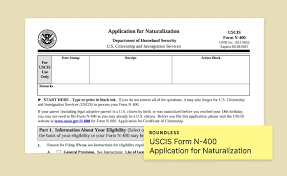

USCIS lays out the overall flow as: apply → biometrics/background checks → interview and testing → decision → oath ceremony.
Prepare your file before you submit
Before you apply, USCIS strongly expects you to be able to support what you write on the N‑400 with documents and consistent records. For example, the N‑400 instructions explain translation rules for foreign-language documents: you must submit a full English translation with a signed translator certification.
If you are applying under the spouse-of-citizen track, USCIS instructions list the types of “required evidence” that can apply, including proof of the spouse’s citizenship and proof of marital history and marriage (and they explicitly mention IRS tax transcripts for the past 3 years as an example of joint evidence).
Submit Form N‑400, online or by mail
USCIS’s N‑400 page states the standard filing fees as of mid‑March 2026:
- $710 if filing online
- $760 if filing on paper
USCIS also highlights a reduced fee option for some applicants (commonly $380) and describes fee waiver pathways for eligible cases.
Biometrics and background checks
USCIS may schedule a biometrics appointment (fingerprints, photo, and signature) as part of background checks. USCIS explains on its “what to expect” page that biometrics come before the interview, and that you must attend if scheduled.
USCIS policy also notes that biometrics are required for naturalization applicants unless a fingerprint waiver applies due to certain medical conditions (handled as an exception process).
Interview and test
At the naturalization interview, the officer reviews your application, your identity, your travel/residence history, and eligibility, and administers English/civics testing unless you qualify for an exception.
Decision and timing after the interview
USCIS policy states it has 120 days from the date of the initial naturalization interview to issue a decision.
Oath ceremony and Certificate of Naturalization
Once USCIS approves the application, it schedules an oath ceremony. USCIS states clearly: you do not become a U.S. citizen until you take the Oath of Allegiance at the ceremony, and USCIS collects your permanent resident card and issues your Certificate of Naturalization.
Costs, timing, and case tracking
Filing fees and legal fee relief options
USCIS confirms the standard N‑400 fees ($710 online / $760 paper) and describes reduced-fee and fee-waiver options.
For fee waivers, USCIS provides Form I‑912 (Request for Fee Waiver) and explains that fee waivers apply only to eligible forms and require proof of inability to pay.
For reduced fees on the N‑400, USCIS also provides Form I‑942 (Request for Reduced Fee) and a dedicated USCIS page that calls out the N‑400 reduced fee amount ($380).
If you qualify under military naturalization provisions, USCIS policy states there are no fees for N‑400 filings under INA 328 or INA 329.
How long it takes
Processing times depend heavily on your assigned field office and your case complexity. USCIS directs applicants to use its official processing-time tools rather than relying on one national “average” timeline.
How to track your case and avoid missed notices
USCIS provides online case tools for tracking, and it is critical that USCIS can reach you by mail.
If you move, USCIS requires most noncitizens—including green card holders—to report a change of address within 10 days, typically using Form AR‑11.
Practical tips, common pitfalls, and what to do next
Start by checking two dates: “Resident Since” and your travel history
Your green card’s “Resident Since” date drives many timelines, but USCIS policy explains that certain categories (like refugees and asylees) can have an effective LPR date that is earlier than the day USCIS approved adjustment—this can change when you first qualify to apply.
Also, be honest and precise about travel. Continuous residence issues are among the most common reasons naturalization timelines reset. USCIS policy explains what happens with trips over 6 months and trips of 1 year or more.
Conditional green card holders need special attention
If you have a conditional green card based on marriage, removal of conditions (Form I‑751) is not optional. USCIS policy explains that officers may need to adjudicate the I‑751 during the naturalization process in certain cases, and it describes scenarios where USCIS should require and decide I‑751 before deciding the N‑400.
Don’t rely on a reentry permit as a “citizenship travel pass”
USCIS policy explains that a reentry permit does not automatically preserve LPR status or guarantee reentry, and USCIS looks at the totality of facts to assess whether you abandoned residence. (This is separate from the naturalization continuous-residence calculation, but it often comes up in the same cases.)
If you will be abroad for qualifying employment and you want to preserve continuous residence for naturalization purposes, USCIS points to Form N‑470 (Application to Preserve Residence).
Avoid common “good moral character” traps
USCIS treats the N‑400’s “additional information” section as a major good‑moral‑character screening tool, and USCIS instructions emphasize the standard applies through the oath.
Some avoidable issues that can create serious problems include:
- claiming U.S. citizenship when you are not a citizen (even on forms),
- not dealing with tax filing/payment obligations,
- and not taking the civics/English requirements seriously (or not using the correct test version).
Voting and voter registration: wait until after the oath
Vote.gov warns clearly: do not register to vote before you are officially a citizen. It states that registering before citizenship can affect your citizenship case.
After the oath: the three updates most new citizens should do
USCIS’s “New U.S. Citizens” page highlights practical next steps after naturalization, including applying for a passport and updating your Social Security record.
- Update your record with the Social Security Administration. SSA says you can apply online for a replacement Social Security card to update your status, and you will bring proof of identity and your new status to an appointment.
- Apply for a U.S. passport. The U.S. Department of State explains the in‑person passport process, including presenting evidence of U.S. citizenship such as a Certificate of Naturalization and following DS‑11 instructions.
- If you have children, confirm whether they may already be U.S. citizens automatically. The State Department explains key Child Citizenship Act criteria (at least one U.S. citizen parent, child is an LPR, and the child resides in the U.S. in the legal and physical custody of the U.S. citizen parent).
A short note on history and today’s system
Modern U.S. naturalization became more standardized over time. The National Archives and Records Administration explains that after 1906, duplicate copies of naturalization certificates and related court records were created—one for the person and one forwarded for federal recordkeeping—reflecting the shift toward standardized documentation.
USCIS also documents the historical development of Certificates of Naturalization during the early and mid‑20th century, showing how the system evolved into the modern identity-and-records framework used today.